
Function
Define Compressive Strength of concrete or the change of modulus of elasticity to reflect the variation of modulus of elasticity with time.
The concrete age of each member is measured from the time the concrete is cast, and each member will have an appropriate compressive strength and modulus of elasticity at each construction stage.
If concrete is poured into different parts of a composite section in stages, the difference in compressive strength and modulus of elasticity of each part, due to the difference in concrete age of each part, can be considered.
To reflect the change in compressive strength of concrete or the change in modulus of elasticity, 'Variation of Comp. Strength' option should be checked in Construction Stage Analysis Control Data.
Call
From the Main Menu select [Properties] tab > [Material Properties] group > [Time Dependent Material] > [Comp. Strength]
Input
Click the Add button to define a new time variant modulus of elasticity (Comp. strength). Click the Modify button and the Delete button to change and delete the data previously entered. Click the Copy button to copy previously entered data.
Name
Enter the name of function defining the time variant modulus of elasticity (Comp. strength) of concrete.
Type
Select Code to define the time dependent compressive strength of concrete, or directly specify the numerical values defining the function.
Development of Strength
When Code is selected in Type, the change of modulus of elasticity is defined by the change of compressive strength.
Code
Select a code defining the change of compressive strength of concrete.
Specify the Concrete Compressive Strength at 28 Days (f28) and Concrete Compressive Strength Factors (a, b).
Note
Modulus of elasticity, which will be reflected in the analysis, is calculated using the compressive strength of concrete and weight density.
When CEB-FIP(2010) is selected
Concrete is classified in three categories of oven-dry density:
- lightweight aggregate concrete (800-2000 kg/m3)
- normal weight concrete (>2000-2600 kg/m3)
- heavyweight concrete (>2600 kg/m3)
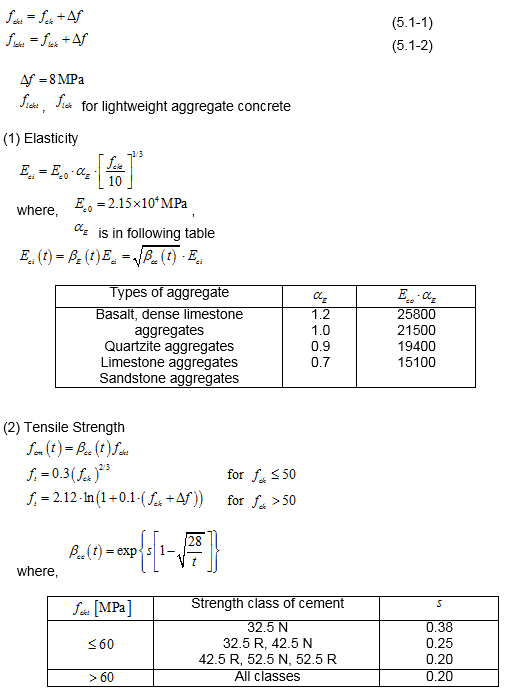
When CEB-FIP(1990) is selected
Specify the Concrete Compressive Strength at 28 Days (fck) and Cement Type (s).
RS : Rapid hardening high strength cements
N, R : Normal or rapid hardening cements
SL : Slowly hardening cements
When Ohzagi is selected
The equation proposed by Ohzagi is used to define the change of compressive strength of concrete. Specify the Concrete
Compressive Strength at 28 Days (S28) and Cement Type Factors (a, b & c).
RS : Rapid hardening high strength cements
N, R : Normal or rapid hardening cements
SL : Slowly hardening cements
Fly ash : Fly ash cementing material
When INDIA(IRC:18-2000) is selected
Following equation is used to define the change of compressive strength of concrete. Specify the Concrete Compressive Strength at 28 Days (S28).
fcj = f28 [2.008 - 1.2134/(log j)0.5]
Where, j : Days
When European is selected
Specify the Concrete Compressive Strength at 28 Days (fck) and Cement Type (s).
Class R : Rapid hardening high strength cements
Class N : Normal or rapid hardening cements
Class S : Slowly hardening cements
When CEB-FIP(1978) is selected
Specify the Concrete Compressive Strength at 28 Days (fck) and Cement Type (s).
Where User is selected, enter the modulus of elasticity varying with time under Time and Elasticity in the table.
The Redraw Graph button : Produce a graph based on the entered data.
Note 1
If User is selected, the entered compressive strength and tensile strength do not affect general analysis, but they are reflected only for the calculation of crack index in heat of hydration analysis.
Note 2
The user may directly input all of modulus of elasticity, compressive strength and tensile strength.
Scale Factor
Enter a multiplier to apply to the values for modulus of elasticity if User Type is assigned.
Graph Options
Check on for Log Scale graph.
Graph Type
The Y-axis of the graph can represent compressive strength, tensile strength or modulus of elasticity.