
Function
Specify a plastic material model for material nonlinear analysis.
Plastic Material Models
Tresca & Von Mises
Appropriate for ductile metals, which exhibit Plastic Incompressibility
Mohr-Coulomb, Drucker-Prager
Appropriate for brittle materials such as concrete, rock and soils, which exhibit the behavior of volumetric plastic straining
Masonry
Appropriate for the elastic analysis finding the crack positions using masonry walls (solid elements).
Note
Masonry material model is applicable to plate, 4-node solid, 6-node solid, and 8-node solid elements.
Call
From the Main Menu select [Properties] tab > [Material Properties] group > [Plastic Material]
Input
For new or additional material properties
Click the Add button in the Plastic Material dialog box and enter the following data :
Name
Name of plastic model
Model
Type of plastic model
Tresca : This yield criterion is suitable for ductile materials such as metals, which exhibit Plastic Incompressibility.
von Mises : This yield criterion is based on distortional strain energy and is the most widely used yield criterion for metallic materials.
Mohr-Coulomb : This yield criterion is a generalization of the Coulomb's friction rule and is suitable for materials such as concrete, rock and soils, which exhibit volumetric plastic deformations.
Drucker-Prager : This criterion is a smooth approximation of the Mohr- Coulomb criterion and is an expansion of the von Mises criterion. This Drucker-Prager criterion is suitable for materials such as concrete, rock and soils, which exhibit volumetric plastic deformations.
Note
For additional details on the above 4 plastic models, refer to "Material Nonlinear Analysis" in the analysis manual.
Masonry : This model is suitable for the elastic analysis finding the crack positions using masonry materials such as bricks, mortar joints, etc
Concrete Damage :
The concrete damaged plasticity model in Midas:
- provides a general capability for modeling concrete and other quasi-brittle materials in all types of structures
(beams, trusses, shells, and solids);
- is designed for applications in which concrete is subjected to monotonic, cyclic, and/or dynamic loading under low confining
pressures ;
- can apply a different yield strengths in tension and compression
- can consider a degradation effect of different elastic strengths in tension and compression
Note
For additional details, refer to "Theory Manual Concrete_Damage model.pdf" .
Plastic Data
If Tresca or Von Mises is selected, specify Initial Uniaxial (tensile) Yield Stress.
If Mohr-Coulomb or Drucker-Prager is selected, specify Initial Cohesion and Initial Friction Angle.
Initial Cohesion
Note
When normal stress is '0', Initial Cohesion is equal to the yield stress due to shear stress only.
Initial Friction Angle
Note
Initial Friction Angle, which is available only if Mohr-Coulomb or Drucker-Prager is selected as the Plastic Material Model, ranges from 0 to 90. Either use the default angle of 30 or specify the angle.
Hardening
As a material yields, hardening defines the change of yield surface with plastic straining, which is classified into the following three types.
Isotropic : Isotropic hardening
Kinematic : Kinematic hardening
Mixed : Mixed type hardening
Note
For additional details on the above 3 plastic models, refer to "Material Nonlinear Analysis" in the analysis manual.
Back Stress Coefficient
Represents the extent of Hardening
'1' for Isotropic Hardening
'0' for Kinematic Hardening
between '0~1' for Mixed Hardening
Note
Total increment of Plastic Hardening can be expressed by Isotropic Hardening and Kinematic Hardening as follows :
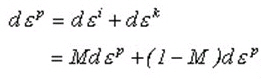
In this case, M refers to the Back Stress Coefficient, and ranges between 0 and 1.
Hardening Coefficient
Tangent stiffness of material after yielding
In general, after the first yielding, the Hardening Coefficient either becomes smaller than the initial tangent stiffness or becomes constant.
Note
In case of von Mises model (Plastic Material), the Hardening Coefficient cannot exceed the Elastic Modulus defined in Model > Property > Material.
When Masonry is selected
Young's Modulus
Poisson's Ratio
Tensile Strength, ft
Stiffness Reduction Factor
Note
Stiffness reduction factor should be greater than "0". If the stiffness reduction factor is "1", stiffness will not be reduced and will remain elastic.
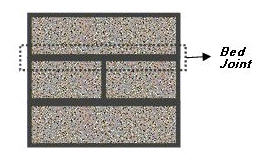
Bed Joint Material Properties
Young's Modulus
Poisson's Ratio
Tensile Strength, ft
Stiffness Reduction Factor
Note
Stiffness reduction factor should be greater than "0". If the stiffness reduction factor is "1", stiffness will not be reduced and will remain elastic.
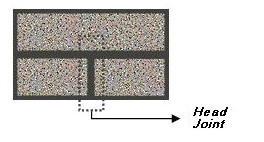
Head Joint Material Properties
Young's Modulus
Poisson's Ratio
Tensile Strength, ft
Stiffness Reduction Factor
Note
Stiffness reduction factor should be greater than "0". If the stiffness reduction factor is "1", stiffness will not be reduced and will remain elastic.
Geometry of Masonry Panel
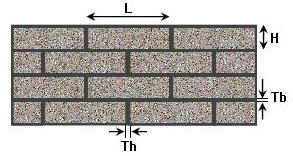
Brick Length, L
Brick Height, H
Thickness of Bed, Tb
Thickness of Head, Th
Material Coordinate System : Orthotropic material properties are assumed for modeling a masonry structure. So it is important to define the Material Coordinate System properly.
Vertical : Horizontal : Select a method to define the Material Coordinate System. The Vertical and Horizontal represent the vertical axis and horizontal axis of a masonry wall respectively.
Global-Y : Global-X : The global-Y axis and the global-X axis must correspond to the gravitational direction and the horizontal direction of the masonry wall respectively.
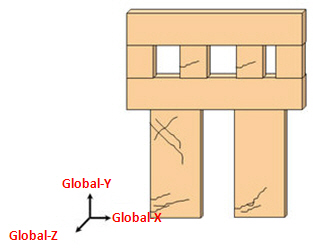
Fig. Material Coordinate System is set as Global-Y : Global-X
Local-y : Local-x : The local-y axis and the local-x axis of elements must correspond to the gravitational direction and the horizontal direction of the masonry wall respectively.
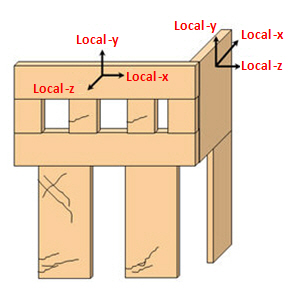
Fig. Material Coordinate System is set as Local-y : Local-x
Global-Z : Angle : The global-Z axis must correspond to the gravitational direction of the masonry wall and the horizontal direction of the wall can be defined by the angle with respect to the global-X axis on the global XY plane. The masonry wall is not necessarily located on the global X-Z plane. It can be rotated about the global-Z axis with any angle from the global-X axis.
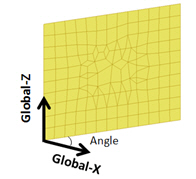
Fig. Material Coordinate System is set as Global-z : Angle
Note
For masonry models where the local axes of elements are not oriented in the same direction, it is better to select Global-Y:Global-X or Global-Z:Angle as the Material Coordinate System.
Q & A
Revision of Gen NX
A1. Here is the explanation about plasticity in concrete with Gen NX.
One parameter models
Under tensile stresses, concrete will fail by a brittle fracture with very little plastic before failure.
Associated fracture criterion: Rankine (Maximum tensile stress criterion)
This is not supported in Gen NX.
Under high hydrostatic pressure (compression), concrete can yield and flow like a ductile metal on the failure (or yield) surface.
Hydrostatic pressure
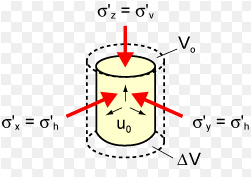
For metals and for concrete in the high pressure range, the effect of hydrostatic pressure on the yield value of material may be neglected. It follows that shearing stress must be the major cause of yielding.
Associated yield criterion:
- Tresca yield criterion (Shear stress criterion)
- Von Mises yield criterion (Shear stress criterion)
This can be simulated with Gen NX.
Two parameter models
In the intermediate stress range, the failure criteria of concrete are sensitive to hydrostatic pressure.
Associated yield criterion:
- Mohr-Coulomb criterion
- Drucker-Prager criterion
Mohr-Coulomb criterion
The failure is governed by the equation below.

c (cohesion) and φ (internal-friction angle) are determined by experiment. This equation is referred to as the Mohr-Coulomb criterion.
c (cohesion) becomes equal to the yield stress in pure shear. c = fc’/sqrt(3) = 4000 psi/sqrt(3) = 2309.4 psi
From the test, m = (1+sin φ)/(1-sin φ) = 4.1. Thus, φ=37.4 degree
The stiffness after yield point can be defined by Hardening Coefficient. The zero value of coefficient represents perfectly plastic or zero stiffness.
The option of hardening rule: Isotropic, Kinematic, Mixes. Hardening rules describe how this yield surface changes in shape as yielding occurs.
Isotropic: Expansion of the yield surface. This is meant for proportional loading only.

Kinematic: Translation of the yield surface. This is meant for cyclic loading.
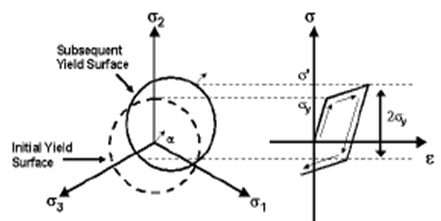
Mixed: Translation and expansion of the yield surface
Note that material nonlinear analysis in Gen NX does not take into account the unloading and reloading. It is recommended that proportional monolithic loading is tried with the Isotropic option.