
Function
Define the values of General Spring Support with 6x6 coupled matrix for stiffness, damping and mass to represent the dynamic properties of pile-soil system.
Call
From the Main Menu select [Boundary] tab > [Springs] group > [General Spring] > [Define General Spring Type]
Input
Name
Enter the name of general nodal spring stiffness.
Input Method
Stiffness Matrix
Mass Matrix : Check on to enter the mass matrix.
Damping Matrix : Check on to enter the damping matrix.
Coupled Spring Stiffness
Enter the values of general nodal spring stiffness.
SDx-SDx
Spring stiffness in x-direction of GCS or node's local coordinate system (when node's local coordinate system is declared)
SDx-SDy
Spring stiffness related to x- and y-direction of GCS or node's local coordinate system (when node's local coordinate system is declared)
SRz-SRz
Rotational spring stiffness about z-direction of GCS or node's local coordinate system (when node's local coordinate system is declared)
Note 1
General spring is normally used to reflect the support stiffness of piles. Pile support stiffness related to each degree-of-freedom are considered in the structural analysis.
In typical building structures, analysis models do not include the pile footings. Instead, boundary springs are assumed to exist at the bottom of foundation or at the pile caps. The following general stiffness offers true stiffness of pile elements. For batter piles, use Node's local Axis to calculate the stiffness in the skewed directions.
Composition of general spring stiffness
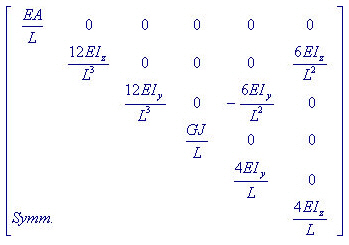
* Assumptions
Modulus of elasticity : E
Section's moments of inertia : Iy, Iz
Cross sectional area : A
Length : L
(Shear deformation not considered)
Note 2 Applicable analysis types with General Spring Support (Damping Matrices)
Related analysis functions are as follows :
Eigenvalue analysis
Response spectrum analysis
Linear time history analysis
Nonlinear time history analysis
Applicable analysis type for damping matrix are as follows :
Response spectrum analysis with Strain Energy Damping
Linear and nonlinear time history analysis (Analysis Method: Modal) with Strain Energy Damping
Linear and nonlinear time history analysis (Analysis Method: Modal) with Strain Energy Damping, Mass & Stiffness Proportional, Element Mass & Stiffness Proportional