
Function
Add, modify or delete the properties of Viscous Damper/ Oil Damper elements.
Call
From the Main Menu select [Boundary] tab > [Advanced] group > [Seismic Device] > [Viscous Damper/ Oil Damper]
Input
To enter or add new properties of Viscous Damper/ Oil Damper elements, click the Add button.
To modify the properties of Viscous Damper/ Oil Damper elements already defined, select a name from the list of Viscous Damper/ Oil Damper property, click the Modify button and change appropriate data entries.
To modify the properties of Viscous Damper/ Oil Damper elements already defined, select a name from the list of Viscous Damper/ Oil Damper properties, click the Delete button and change appropriate data entries.
Name
Enter the name of Seismic Device.
Input Method
User input : Select the Damper type, Dashpot type and Properties by user define.
Import Reference DataBase : Select the device among the registered Data Base. Damper type, Dashpot type and Properties are automatically entered for the registered Data Base.
Dashpot Type
Select the damper to be applied in the model. The type of dampers are as follow.
Single Dashpot Model : It only has a damping effect.
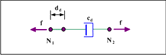
Fig. Single Dashopt Model
Kelvin(Voigt) Model : The stiffness and damping of damper are connected in parallel.
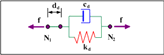
Fig. Kelvin(Voigt) Model
Maxwell Model : The stiffness and damping of damper are connected in series.
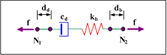
Fig. Maxwell Model
Damper Type
Select the Hysteretic model for damping coefficient.
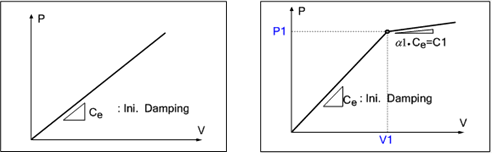
Fig. Linear Elastic Type Fig. Elastic Brilinear Type
Input Type
Damping Reduction Ratio (α1) : Enter the α1 to calculate the slope of the relaxation zone by multiplying with the initial damping coefficient in Elastic Bilinear type.
Damping (C1) : Enter the damping coefficient corresponding to the slope of the relaxation zone in the Elastic Bilinear type.
Dashpot Properties
Initial Damping Coefficient (Ce) : Enter the Damping Coefficient of the Spec. of damper.
Relief Damping Force (P1) : Enter the damping force at which the relaxation zone in Elastic Bilinear type.
Relief Velocity (V1 = P1 / Ce) : Calculated automatically by dividing damping force into the damping coefficient.
Second Damping Coefficient (C1) : Enter the damping coefficient corresponding to the slope of the relaxation zone in the Elastic Bilinear type.
Damping Reduction Factor (α1) : Enter the α1 to calculate the slope of the relaxation zone by multiplying with the initial damping coefficient in Elastic Bilinear type.
Spring Property
Enter the spring stiffness of the damper.